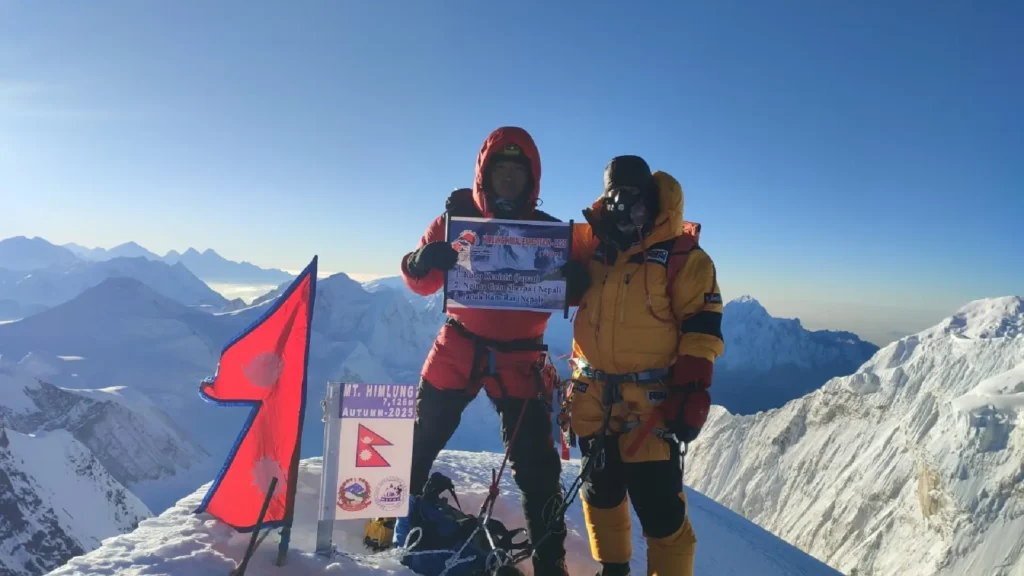
Mt. Putha Hiunchuli Expedition – North Face (Standard Route)
Group Size
2-10 Persons
Max-Elevation
7,246 m / 23,773 ft
Accommodation
Hotel, Lodge & Tent
Daily Trekking
4-8 Hours
Best Season
Spring/Autumn
Grade
Moderately Challenging / High-Altitude
Best Season
Spring (April–May)
Group Size
2–15 Pax
Maximum Elevation
8,848.86 m / 29,032 ft
Accommodation
Hotel, Lodge & Tent
Daily Trekking
5–7 Hours
Trip Overview
Rising majestically at 7,246 m (23,773 ft), Putha Hiunchuli—also known as Dhaulagiri VII—marks the westernmost summit of Nepal’s famous Dhaulagiri Range. This elegant, snow-capped peak stands above the mystical Dolpo region, made legendary by Peter Matthiessen’s The Snow Leopard. Offering vast open glaciers, serene valleys, and a deep sense of isolation, the Putha Hiunchuli Expedition is one of Nepal’s most authentic and rewarding wilderness climbs.
First ascended in 1954 by J.O.M. (Jimmy) Roberts and Ang Nyima Sherpa, Putha Hiunchuli is renowned for its broad, glaciated northern slopes, averaging 30°–35°, and its long, scenic approach. It’s a technically moderate but physically demanding expedition—ideal for climbers looking to transition from 6000 m peaks to higher Himalayan objectives or to train for 8000 m mountains such as Dhaulagiri I or Manaslu.
This climb is unique in its remoteness and purity. The route begins with a flight to Juphal (Dolpo), followed by a scenic trek through ancient Bon villages, alpine valleys, and high passes before reaching Base Camp at 4,910 m. The ascent follows a three-camp strategy (C1: 5,300 m → C2: 5,900 m → C3: 6,300 m), culminating in a long but rewarding summit day with panoramic views of Dhaulagiri I, Churen Himal, and Kanjiroba Himal.
With Royal Orchid Treks & Expedition, climbers are supported by a professional Sherpa team, comprehensive logistics, and a safety-first approach. Putha Hiunchuli remains one of Nepal’s best 7000 mclimbs—a true Himalayan adventure blending culture, solitude, and accomplishment.
Remote and rarely climbed 7000 m peak in the Dolpo wilderness
Ideal for climbers training for 8000 m expeditions
Gentle northern slopes — perfect for ski mountaineering and alpine-style ascent
Low objective hazard, broad glacier approach, and steady acclimatization
Cultural immersion through ancient Bon and Tibetan-influenced villages
Professionally guided by Royal Orchid’s veteran Sherpa team
A perfect balance of technical ease and high-altitude challenge
Route & Camp Highlights – Mt. Putha Hiunchuli
Base Camp – 4,910 m
Set on a wide, glaciated valley beneath the northern face, Base Camp offers expansive views of the Dhaulagiri range. Fully equipped with personal tents, dining tents, kitchen facilities, and communication support, it serves as the operational hub for the entire expedition.
Camp I – 5,300 m
Reached after a gradual ascent over broad glacial moraine and snow terrain, Camp I is positioned on a stable shelf ideal for acclimatization and early load carries. The surrounding open slopes provide a smooth introduction to higher elevations.
Camp II – 5,900 m
Camp II lies on a wide, gently angled snow plateau. This camp marks the transition into the upper mountain and serves as a critical acclimatization point before the final push. Snow slopes average around 30°–35°, making travel steady but not overly technical.
Camp III – 6,300 m
The high camp is established on a sheltered section below the summit dome. From here, climbers prepare for the long summit bid, checking weather, equipment, and pacing for the final ascent.
Summit – 7,246 m
The summit day features a sustained climb on broad glaciated terrain, moderate snow slopes, and a final ridge opening to spectacular views of Dhaulagiri I, Churen Himal, Kanjiroba Himal, and the remote Dolpo landscape. This summit offers one of the most serene and panoramic vistas in western Nepal.
Arrive at Tribhuvan International Airport. Our staff will meet and transfer you to your hotel. Rest and recover from your journey.
| Hotel
Day 2 – Expedition Briefing & Preparation
Attend official expedition briefing, finalize permits, and inspect personal gear. Evening welcome dinner. | B/D | Hotel
Day 3 – Fly Kathmandu → Nepalgunj (150 m)
Short flight to the gateway of western Nepal. Explore the lowland city and rest overnight.
|B/L/D | Hotel
Day 4 – Fly Nepalgunj → Juphal (2,470 m) – Drive to Dunai (2,150 m)
A thrilling mountain flight into Dolpo followed by a short drive to Dunai, the district headquarters. |B/L/D | Lodge
Day 5 – Trek Dunai → Tarakot (2,537 m)
Begin your trek along the Barbung Khola River through traditional villages and terraced fields. |B/L/D | Tent
Day 6 – Trek Tarakot → Musi Khola (2,875 m)
Ascend steadily through pine forests and small settlements beside glacial streams. | B/L/D | Tent
Day 7 – Trek Musi Khola → Kagkot (3,200 m)
Follow an undulating trail into the heart of the Dolpo Valley surrounded by pristine Himalayan scenery. | B/L/D | Tent
Day 8 – Acclimatization Day in Kagkot
Rest and explore this highland village with its traditional Tibetan culture. Short hikes aid acclimatization. | B/L/D | Tent
Day 9 – Trek Kagkot → Panjing (4,200 m)
Gradual climb along river valleys and high pastures to Panjing, a beautiful meadow beneath snow peaks. | B/L/D | Tent
Day 10 – Trek Panjing → German Base Camp (4,500 m)
Trek across alpine terrain toward the base of the Putha Hiunchuli glacier. | B/L/D | Tent
Days 11–13 – Move to Putha Hiunchuli Base Camp (4,910 m)
Establish the main Base Camp beside the glacier. Team sets up tents, kitchen, and communication systems. | B/L/D | Tent
Days 14–29 – Climbing Period (Base Camp ↔ Camp I → Camp II → Camp III → Summit 7,246 m → Base Camp)
Begin rotation climbs to higher camps, acclimatizing and ferrying loads. Final summit push starts before dawn from Camp III. Climb steady snow slopes to the summit, rewarded by incredible views of the Dhaulagiri massif and Dolpo wilderness. Return safely to Base Camp. | Full Board | Tent
Day 30 – Descend Base Camp → Kagkot (3,200 m)
Retrace your route through glaciers and meadows to Kagkot. | B/L/D | Tent
Day 31 – Trek Kagkot → Lashicap (2,775 m)
Descend through forested trails and river valleys. | B/L/D | Tent
Day 32 – Trek Lashicap → Dunai (2,150 m)
Final day of trekking. Return to Dunai and celebrate your expedition’s success. | B/L/D |Lodge
Morning drive and connecting flights back to Kathmandu. Transfer to hotel. | B/L | Hotel
Day 34 – Leisure Day in Kathmandu
Relax, shop, or explore cultural landmarks like Boudhanath or Swayambhunath. | Breakfast |Hotel
Day 35 – Final Departure
Transfer to Tribhuvan International Airport for your onward flight. | Breakfast
Why Royal Orchid Trek for Mt. Putha Hiunchuli Expedition – North Face (Standard Route)
1. Sherpa Leadership With Deep Experience Across Dolpo & Dhaulagiri
Our Sherpa guides have extensive experience in the Dhaulagiri region, including multiple successful ascents of Putha Hiunchuli. Their knowledge of the remote Dolpo terrain, altitude, and seasonal snow conditions ensures safe and informed decision-making throughout the climb.
2. Expert High-Altitude Sherpa Team for a Remote 7,000 m Peak
The north face of Putha Hiunchuli requires strong glacier travel skills, fixed-rope efficiency, and careful pacing. Our high-altitude Sherpa team manages rope fixing, load carries, route safety, and summit support—giving climbers reliable technical guidance on this moderately challenging Himalayan peak.
3. Safe, Proven Acclimatization Strategy With Three High Camps
We follow a structured rotation schedule between Camp I, Camp II, and Camp III, designed specifically for Putha Hiunchuli’s broad glaciated terrain. Daily health monitoring, weather analysis, and a high Sherpa-to-client ratio ensure a safe and steady ascent profile.
4. Complete Expedition Logistics in Nepal’s Most Remote Region
From flights to Juphal and porter support to comfortable tented camps, Royal Orchid ensures a seamless expedition. Our Base Camp and high camps are equipped with nutritious meals, professional kitchen staff, communication systems, and carefully managed load logistics—all crucial for a successful climb in Dolpo’s wilderness.
As a Sherpa-owned company, we prioritize fair wages, full insurance for staff, environmentally responsible practices, and support for local communities. We run small, focused teams, allowing for personalized guidance, flexible decision-making, and a more meaningful Himalayan journey.